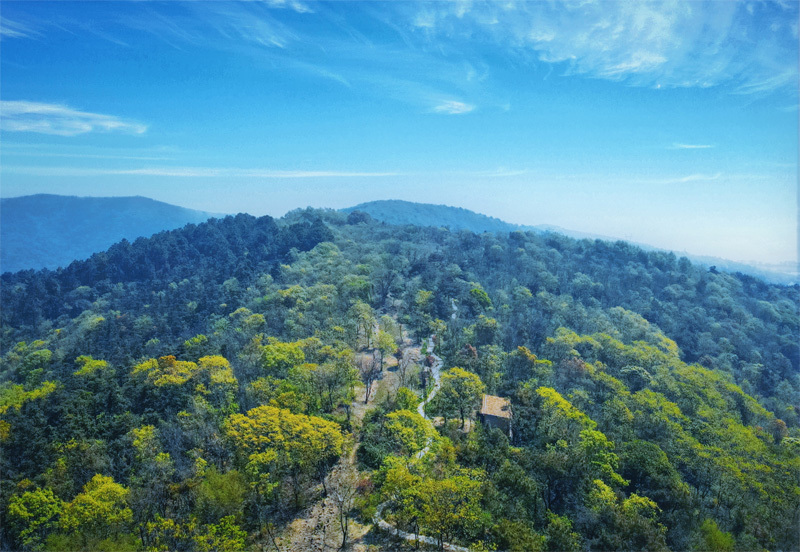
First Stop - Remembering the Mountain: The Longshan Stone Wall Site
The tides of history rise and fall, plants wither and flourish year after year, time is fleeting but memories are eternal. Let us use the nerves of our lives to perceive the mountains and rivers that support our memories.
Along the north bank of Taihu Lake, winding for eighteen bays, lies a dragon-shaped mountain range—Longshan. As the saying goes, “Mountains are not high, but renowned for their immortals.” On the Longshan ridge, with an average altitude of over one hundred meters, are more than one hundred ancestral stone mounds (also known as stone chamber tumuli) scattered like pearls. On top of or alongside the stone mounds, extending intermittently for about 20 li, is a stone wall—the Longshan Stone Wall. These weathered ruins, along with the remains of the city of Helu, are relics of the late Spring and Autumn period Wu kingdom, having weathered 2500 years of wind, frost, snow, and rain. Such a unique historical and cultural landscape seems to tell the story of Wu Zixu's military strategy—ingeniously using the terrain and manpower, “building a city to protect the ruler, and constructing a walled town to guard the people.” Longshan was transformed into the first line of defense for Helu City, forming a complete military defense system with the ancient Xuhua Lake, the main Helu City, the east and west cities.
发布时间:2022-05-06 07:47
-
File size: 1.5MB
Previous Page
Previous Page